**STRONG WEAVE**
Bibi Russel not only believes that fashion designers have a responsibility towards society, she is practicing it too.
**BY PALLAVI MAJUMDER**
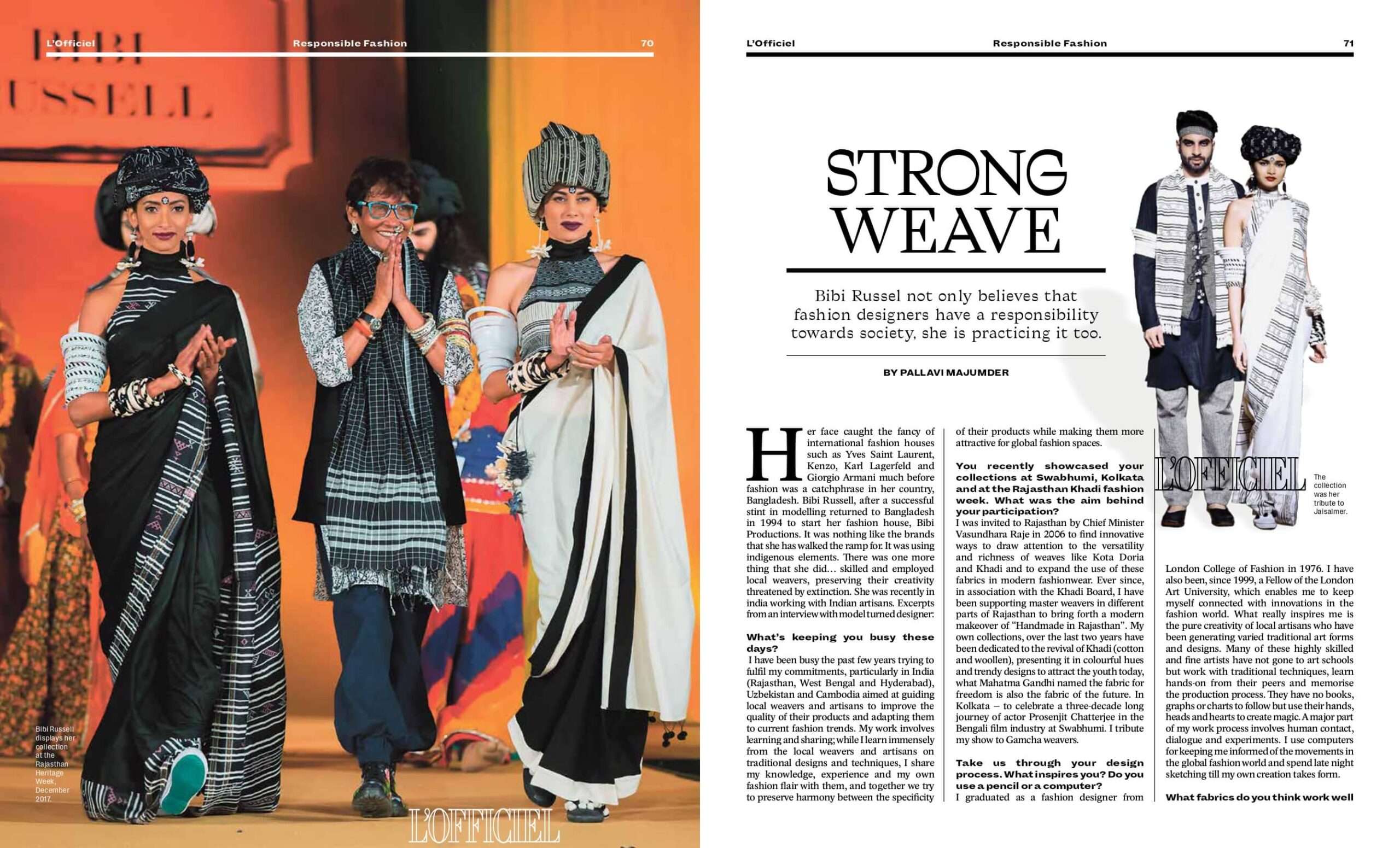
Her face caught the fancy of international fashion houses such as Yves Saint Laurent, Kenzo, Karl Lagerfeld and Giorgio Armani much before fashion was a catchphrase in her country, Bangladesh. Bibi Russell, after a successful stint in modelling returned to Bangladesh in 1994 to start her fashion house, Bibi Productions. It was nothing like the brands that she has walked the ramp for. It was using indigenous elements. There was one more thing that she did… skilled and employed local weavers, preserving their creativity threatened by extinction. She was recently in india working with Indian artisans. Excerpts from an interview with model turned designer:
**What’s keeping you busy these days?**
I have been busy the past few years trying to fulfil my commitments, particularly in India (Rajasthan, West Bengal and Hyderabad), Uzbekistan and Cambodia aimed at guiding local weavers and artisans to improve the quality of their products and adapting them to current fashion trends. My work involves learning and sharing; while I learn immensely from the local weavers and artisans on traditional designs and techniques, I share my knowledge, experience and my own fashion flair with them, and together we try to preserve harmony between the specificity of their products while making them more attractive for global fashion spaces.
**You recently showcased your collections at Swabhumi, Kolkata and at the Rajasthan Khadi fashion week. What was the aim behind your participation?**
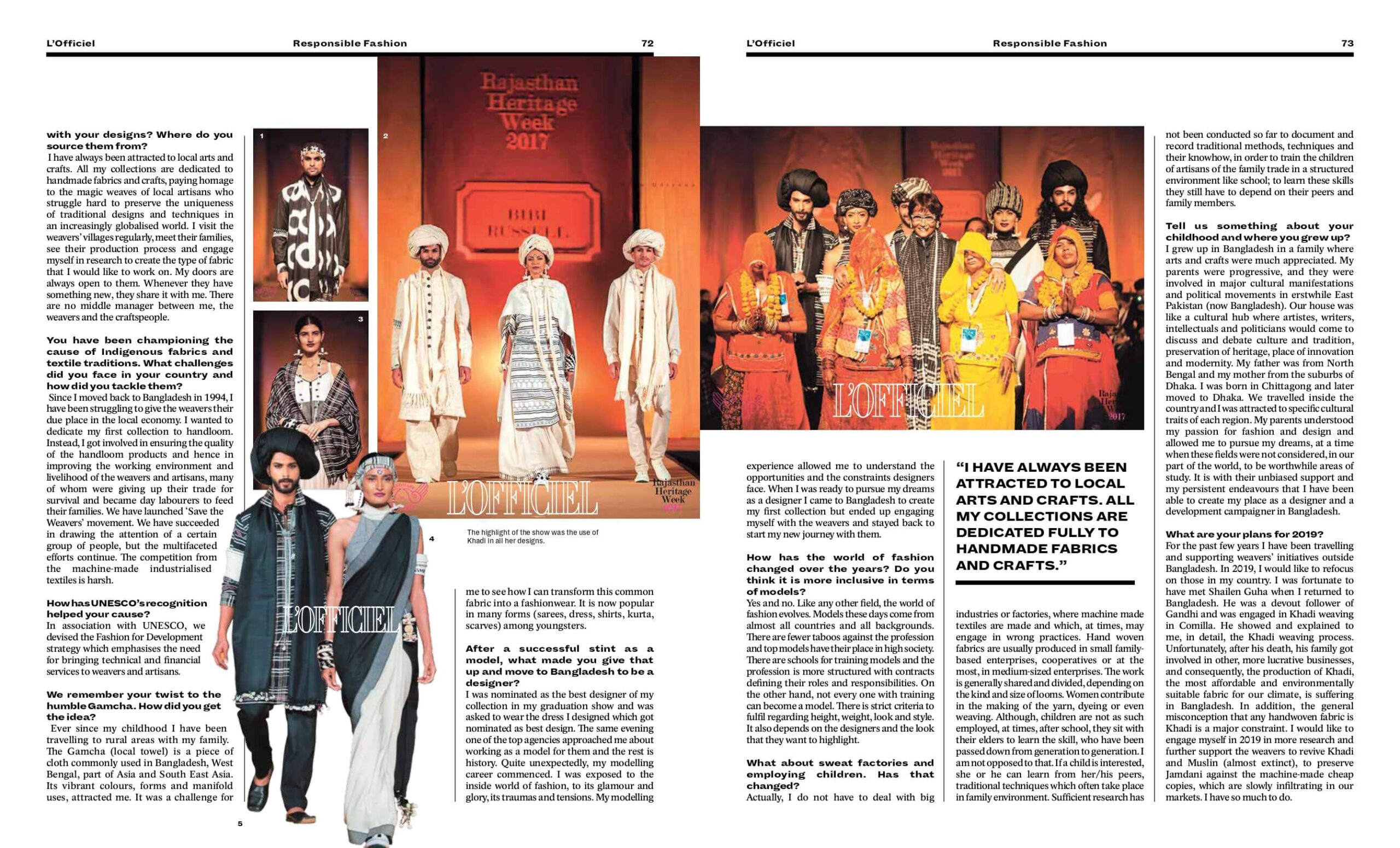
I was invited to Rajasthan by Chief Minister Vasundhara Raje in 2006 to find innovative ways to draw attention to the versatility and richness of weaves like Kota Doria and Khadi and to expand the use of these fabrics in modern fashionwear. Ever since, in association with the Khadi Board, I have been supporting master weavers in different parts of Rajasthan to bring forth a modern makeover of “Handmade in Rajasthan”. My own collections, over the last two years have been dedicated to the revival of Khadi (cotton and woollen), presenting it in colourful hues and trendy designs to attract the youth today, what Mahatma Gandhi named the fabric for freedom is also the fabric of the future. In Kolkata – to celebrate a three-decade long journey of actor Prosenjit Chatterjee in the Bengali film industry at Swabhumi. I tribute my show to Gamcha weavers.
**Take us through your design process. What inspires you? Do you use a pencil or a computer?**
I graduated as a fashion designer from London College of Fashion in 1976. I have also been, since 1999, a Fellow of the London Art University, which enables me to keep myself connected with innovations in the fashion world. What really inspires me is the pure creativity of local artisans who have been generating varied traditional art forms and designs. Many of these highly skilled and fine artists have not gone to art schools but work with traditional techniques, learn hands-on from their peers and memorise the production process. They have no books, graphs or charts to follow but use their hands, heads and hearts to create magic. A major part of my work process involves human contact, dialogue and experiments. I use computers for keeping me informed of the movements in the global fashion world and spend late night sketching till my own creation takes form.
**What fabrics do you think work well with your designs? Where do you source them from?**
I have always been attracted to local arts and crafts. All my collections are dedicated to handmade fabrics and crafts, paying homage to the magic weaves of local artisans who struggle hard to preserve the uniqueness of traditional designs and techniques in an increasingly globalised world. I visit the weavers’ villages regularly, meet their families, see their production process and engage myself in research to create the type of fabric that I would like to work on. My doors are always open to them. Whenever they have something new, they share it with me. There are no middle manager between me, the weavers and the craftspeople.
**You have been championing the cause of Indigenous fabrics and textile traditions. What challenges did you face in your country and how did you tackle them?**
Since I moved back to Bangladesh in 1994, I have been struggling to give the weavers their due place in the local economy. I wanted to dedicate my first collection to handloom. Instead, I got involved in ensuring the quality of the handloom products and hence in improving the working environment and livelihood of the weavers and artisans, many of whom were giving up their trade for survival and became day labourers to feed their families. We have launched ‘Save the Weavers’ movement. We have succeeded in drawing the attention of a certain group of people, but the multifaceted efforts continue. The competition from the machine-made industrialised textiles is harsh.
**How has UNESCO’s recognition helped your cause?**
In association with UNESCO, we devised the Fashion for Development strategy which emphasises the need for bringing technical and financial services to weavers and artisans.
**We remember your twist to the humble Gamcha. How did you get the idea?**
Ever since my childhood I have been travelling to rural areas with my family. The Gamcha (local towel) is a piece of cloth commonly used in Bangladesh, West Bengal, part of Asia and South East Asia. Its vibrant colours, forms and manifold uses, attracted me. It was a challenge for me to see how I can transform this common fabric into a fashionwear. It is now popular in many forms (sarees, dress, shirts, kurta, scarves) among youngsters.
**After a successful stint as a model, what made you give that up and move to Bangladesh to be a designer?**
I was nominated as the best designer of my collection in my graduation show and was asked to wear the dress I designed which got nominated as best design. The same evening one of the top agencies approached me about working as a model for them and the rest is history. Quite unexpectedly, my modelling career commenced. I was exposed to the inside world of fashion, to its glamour and glory, its traumas and tensions. My modelling experience allowed me to understand the opportunities and the constraints designers face. When I was ready to pursue my dreams as a designer I came to Bangladesh to create my first collection but ended up engaging myself with the weavers and stayed back to start my new journey with them.
**How has the world of fashion changed over the years? Do you think it is more inclusive in terms of models?**
Yes and no. Like any other field, the world of fashion evolves. Models these days come from almost all countries and all backgrounds. There are fewer taboos against the profession and top models have their place in high society. There are schools for training models and the profession is more structured with contracts defining their roles and responsibilities. On the other hand, not every one with training can become a model. There is strict criteria to fulfil regarding height, weight, look and style. It also depends on the designers and the look that they want to highlight.
**What about sweat factories and employing children. Has that changed?**
Actually, I do not have to deal with big industries or factories, where machine made textiles are made and which, at times, may engage in wrong practices. Hand woven fabrics are usually produced in small family-based enterprises, cooperatives or at the most, in medium-sized enterprises. The work is generally shared and divided, depending on the kind and size of looms. Women contribute in the making of the yarn, dyeing or even weaving. Although, children are not as such employed, at times, after school, they sit with their elders to learn the skill, who have been passed down from generation to generation. I am not opposed to that. If a child is interested, she or he can learn from her/his peers, traditional techniques which often take place in family environment. Sufficient research has not been conducted so far to document and record traditional methods, techniques and their knowhow, in order to train the children of artisans of the family trade in a structured environment like school; to learn these skills they still have to depend on their peers and family members.
> **“I HAVE ALWAYS BEEN ATTRACTED TO LOCAL ARTS AND CRAFTS. ALL MY COLLECTIONS ARE DEDICATED FULLY TO HANDMADE FABRICS AND CRAFTS.”**
**Tell us something about your childhood and where you grew up?**
I grew up in Bangladesh in a family where arts and crafts were much appreciated. My parents were progressive, and they were involved in major cultural manifestations and political movements in erstwhile East Pakistan (now Bangladesh). Our house was like a cultural hub where artistes, writers, intellectuals and politicians would come to discuss and debate culture and tradition, preservation of heritage, place of innovation and modernity. My father was from North Bengal and my mother from the suburbs of Dhaka. I was born in Chittagong and later moved to Dhaka. We travelled inside the country and I was attracted to specific cultural traits of each region. My parents understood my passion for fashion and design and allowed me to pursue my dreams, at a time when these fields were not considered, in our part of the world, to be worthwhile areas of study. It is with their unbiased support and my persistent endeavours that I have been able to create my place as a designer and a development campaigner in Bangladesh.
**What are your plans for 2019?**
For the past few years I have been travelling and supporting weavers’ initiatives outside Bangladesh. In 2019, I would like to refocus on those in my country. I was fortunate to have met Shailen Guha when I returned to Bangladesh. He was a devout follower of Gandhi and was engaged in Khadi weaving in Comilla. He showed and explained to me, in detail, the Khadi weaving process. Unfortunately, after his death, his family got involved in other, more lucrative businesses, and consequently, the production of Khadi, the most affordable and environmentally suitable fabric for our climate, is suffering in Bangladesh. In addition, the general misconception that any handwoven fabric is Khadi is a major constraint. I would like to engage myself in 2019 in more research and further support the weavers to revive Khadi and Muslin (almost extinct), to preserve Jamdani against the machine-made cheap copies, which are slowly infiltrating in our markets. I have so much to do.